
When 70% of Family Court Litigants Walk In Alone, the Record Becomes the Case
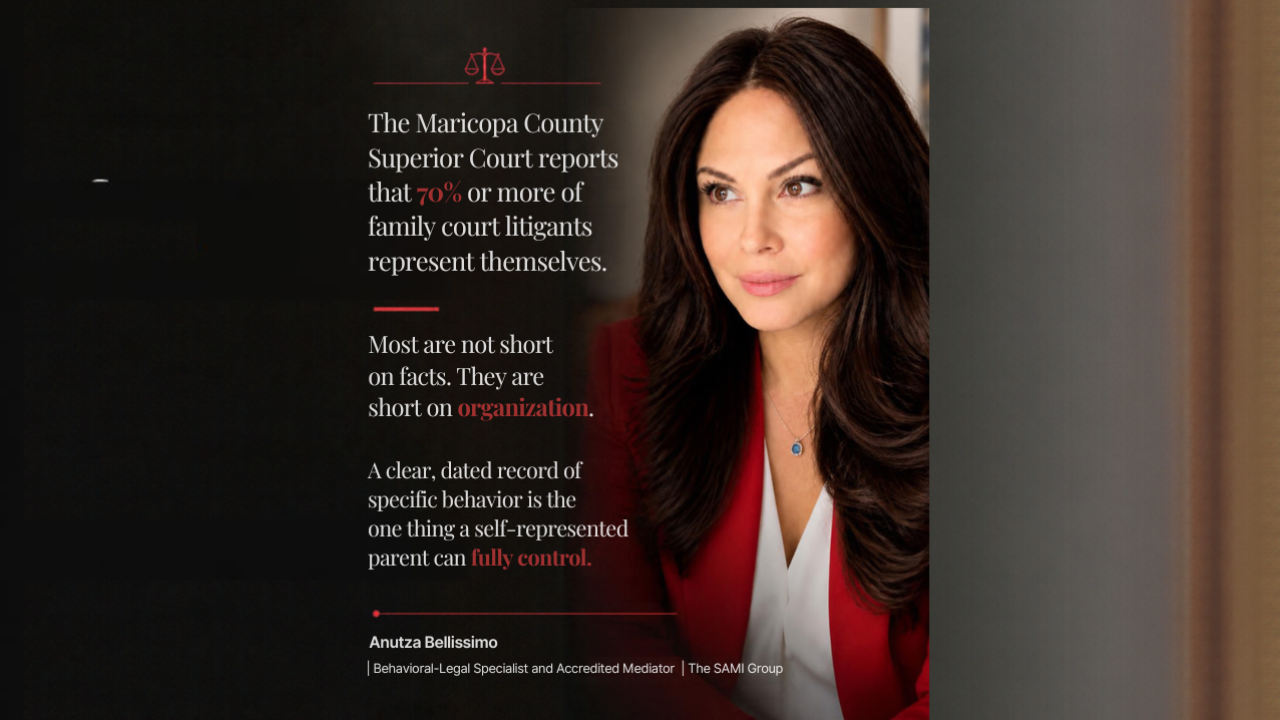
The Maricopa County Superior Court reports that 70% or more of family court litigants represent themselves.
The court has responded by piloting an Informal Family Law Trial. It condenses the process, lets the judge guide the parties through it, and removes cross-examination. In the court’s own words, litigants will not need to understand the rules of evidence to present their case. The judge decides how much each statement matters.
What that establishes: in a room without attorneys, the person who presents the clearest account of what happened gives the judge the most to work with.
What I see after 26 years in behavior
Most self-represented parents are not short on facts. They are short on organization.
They arrive with months of events held in memory, shaped by stress. They describe conclusions: “They are controlling.” “They are impossible.” What a judge can weigh is conduct: what was said, what was done, on what date, and in what words.
Judges do not rule on feelings. They rule on what can be shown.
Why this matters more in Arizona now
On June 22, 2026, the Alec and Lydia Act (HB 2995) took effect. For the first time, Arizona’s family court framework recognizes coercive control as domestic violence in custody and parenting-time cases. The statute describes coercive control as a pattern, and it requires courts to resolve domestic violence allegations through detailed written findings.
A pattern is not proven by how convincing it feels. It is proven by specific, repeated conduct that is dated and saved. Arizona’s evidence rules draw the same line. Rule 406 allows evidence of a regular response to a repeated situation, while courts remain wary of general character labels used in their place.
The same logic runs in both directions. Under Rule 801(d)(2), a party’s own statement offered against them is not hearsay. The other parent’s messages can be used against them, and yours can be used against you. Behavior is evidence, including your own.
Where a behavioral-legal specialist fits
I am not an attorney, and I do not give legal advice. My role is to help people turn what happened into a record that can be read and understood.
That work comes down to three things:
- Separating conduct from conclusions. “On March 3 at 9:40 p.m., I received this message” is a record. “They are always like this” is an opinion.
- Organizing the timeline. Dated entries, full message threads, and the sender’s number or address are what allow an item to be identified as authentic under Rule 901.
- Preparing for the room. How you carry yourself under pressure is observed and remembered. Training in pausing before you respond protects your record as much as your documentation does.
Where an accredited mediator fits
A mediator is neutral. Our job is to help the parties reach their own agreement, not to take a side. Mediation goes better when both people arrive prepared and regulated, which is why the work before the room matters.
That neutrality sets a boundary. I prepare people for mediation through education and training, and I do not mediate a matter in which I have prepared one of the parties.
How I can help through Behavior Is Evidence
- Pattern documentation. Education on building a dated, specific behavioral record, including The Behavior Log.
- Mediation Readiness Training. A three-session program that prepares participants for the mediation room.
- Workshops for attorneys and HR professionals. Practical sessions on documenting conduct and managing conflict before it escalates.
- Ongoing education. Short, plain-language content on evidence, behavior, and conflict.
Start with the record
You may not get to choose the process, but you can choose how organized you are when you enter it. The record is the one part that no one else can build for you.
Behavior Is Evidence.
This article is for education only and is not legal advice. Consult a licensed Arizona attorney about your case.
Anutza Bellissimo | Behavioral-Legal Specialist and Accredited Mediator | The SAMI Group
#BehaviorIsEvidence #FamilyLaw #Mediation #ConflictResolution #CoerciveControl